
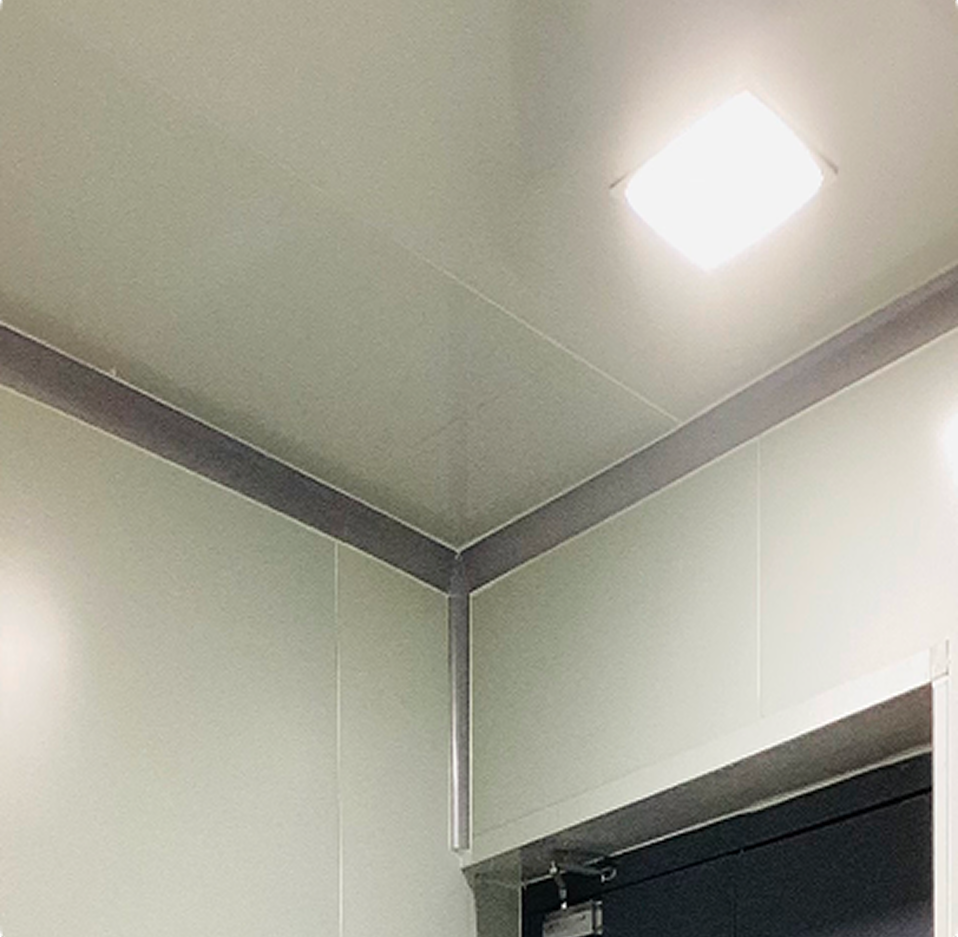
Creating a contamination-free clean room requires more than high-grade walls, partitions, and air systems. One of the most overlooked yet critical components in clean room construction is aluminium coving—the curved transition profile installed between wall-to-wall, wall-to-ceiling, and wall-to-floor joints. These corners are the highest-risk zones for particle accumulation, moisture buildup, and microbial growth. Aluminium coving eliminates sharp angles and replaces them with smooth, rounded surfaces that are far easier to clean and maintain.
Clean rooms operate on strict GMP and ISO standards, where every millimetre of finishing matters. Traditional 90-degree corners create micro-gaps that trap dust and create cleaning challenges. Aluminium coving provides a seamless, unbroken radius that ensures there are no edges for contaminants to rest. This is especially critical in pharma manufacturing, biotech labs, modular OTs, food processing units, and electronics clean rooms where even a tiny particle can compromise product safety.
Another major advantage of aluminium coving is its structural durability. Unlike PVC or FRP coving, aluminium does not warp, crack, or deform when exposed to chemicals, temperature fluctuations, or repeated cleaning cycles. It maintains its shape, ensures long-lasting flush integration, and contributes to a stronger clean room envelope. This makes it a preferred choice for facilities that require long operational lifespans and zero compromise on sterility.
From an installation perspective, aluminium coving supports perfect alignment with clean room panels, flush doors, partition systems, and modular ceilings. It enhances the room’s pressure integrity by eliminating leak-prone joints. AUM Industries engineers its coving profiles with precision to deliver repeatable accuracy, tight tolerances, and complete compatibility with clean room modules. The result is a clean room that not only performs better but also looks visually seamless and professionally finished.
In environments where compliance, hygiene, and durability are non-negotiable, aluminium coving stands out as a foundational component. Its role may be subtle, but its impact on sterility and long-term performance is significant. For any facility aiming to build fully flush, future-ready clean rooms, aluminium coving is not just important—it is essential.
Add a Comment