
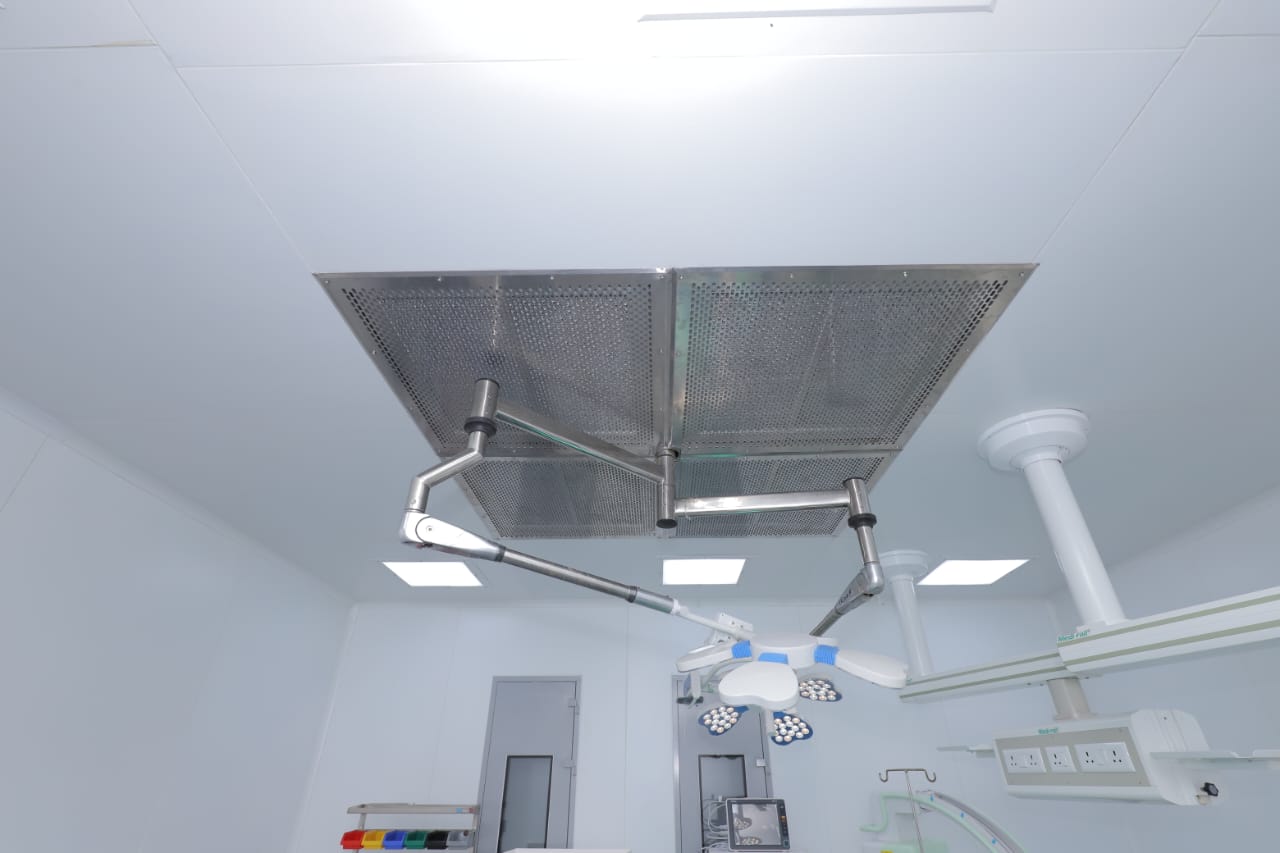
In an operation theatre, precision is not limited to surgical instruments or medical expertise. The air itself plays a crucial role in patient safety. Even microscopic airborne particles can increase the risk of surgical site infections (SSIs), leading to complications, prolonged hospital stays, and higher treatment costs.
This is where laminar air flow becomes essential.
At AUM Industries, we design and execute operation theatre environments where air quality is controlled, directional, and compliant with healthcare standards — because in critical spaces, nothing can be left to chance.
What Is Laminar Air Flow?
Laminar Air Flow (LAF) is a ventilation system that moves filtered air in a uniform, unidirectional flow — usually vertically from ceiling to floor in operation theatres.
Unlike conventional airflow systems that mix and circulate air randomly, laminar airflow pushes clean air downward in parallel streams. This controlled movement helps remove contaminants away from the surgical zone and prevents them from recirculating.
In simple terms, it creates a protective curtain of ultra-clean air over the operating table.
Why Air Control Matters in Surgery
During surgery, several factors generate airborne particles:
Movement of medical staff
Skin particles and microorganisms
Opening of doors
Surgical instruments and equipment
Without proper airflow management, these particles remain suspended and may settle in the sterile surgical field.
Laminar airflow systems, combined with HEPA filtration, significantly reduce airborne bacterial contamination. This directly lowers infection risks, especially in orthopedic, cardiac, neurosurgery, and implant procedures where sterility is critical.
The Role of Turnkey Execution
For hospitals investing in new infrastructure, laminar airflow should be integrated at the planning stage — not treated as an add-on feature.
A well-executed modular OT with integrated laminar airflow ensures:
Long-term infection control performance
Energy-efficient operation
Regulatory compliance
Reduced maintenance issues
At AUM Industries, we approach OT infrastructure as a controlled ecosystem where airflow, filtration, pressure, and materials work together to maintain sterile integrity.
Final Thoughts
In operation theatres, infection prevention is not optional — it is fundamental.
Laminar Air Flow is critical because it transforms the invisible element of air into a controlled, protective shield over patients and surgeons. When designed and executed correctly, it becomes one of the most powerful tools in surgical safety.
For hospitals aiming to upgrade their OT infrastructure or develop new modular operation theatres, investing in properly engineered laminar airflow systems is not just a technical decision — it is a commitment to patient safety and clinical excellence.
Add a Comment