
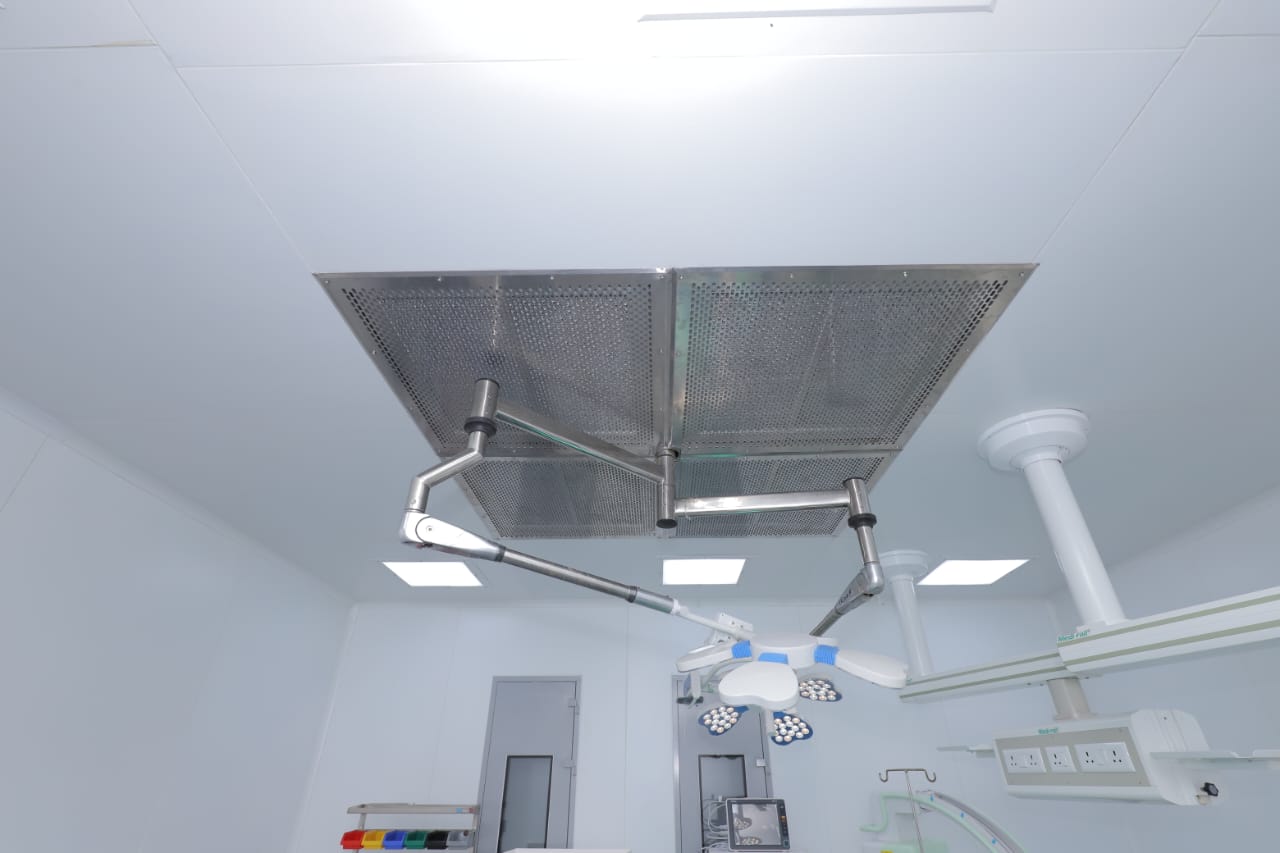
In modern healthcare infrastructure, patient safety begins long before the first incision is made. It starts with the environment inside the operation theatre. Among all critical components of a Modular OT, Laminar Air Flow (LAF) plays one of the most vital roles in infection control.
For hospitals aiming to reduce surgical site infections (SSI) and maintain NABH or international compliance standards, laminar airflow is not an option — it is a necessity.
Understanding Laminar Air Flow
Laminar Air Flow is a controlled air distribution system that delivers filtered air in a uniform, unidirectional stream. Unlike conventional ventilation systems that circulate air randomly, laminar flow ensures a steady downward movement of clean air over the surgical area.
This constant vertical airflow pushes contaminated particles away from the operating zone and towards return air grills, minimizing the risk of airborne contamination.
In simpler terms, it creates a protective air curtain around the patient and surgical team.
Why Infection Control Depends on It
Operation theatres are highly sensitive environments. Even microscopic airborne particles can carry bacteria that lead to post-surgical complications. Studies have shown that air contamination is a major contributor to surgical site infections.
By continuously supplying HEPA-filtered air, these systems significantly reduce the presence of contaminants around the surgical table.
Role of HEPA Filtration
A Laminar Air Flow system is incomplete without high-efficiency filtration. HEPA filters remove 99.97% of particles as small as 0.3 microns. This includes dust, microbes, and other airborne contaminants.
For hospitals performing orthopedic, cardiac, transplant, or high-risk surgeries, maintaining ultra-clean air standards is critical. Even minor lapses in air quality can impact recovery outcomes.
Compliance and Regulatory Standards
Modern healthcare guidelines and accreditation bodies emphasize controlled air environments in operation theatres. Parameters such as air changes per hour (ACH), pressure differentials, temperature, and humidity must be carefully maintained.
A properly designed laminar airflow system helps hospitals meet these stringent requirements while ensuring long-term operational efficiency.
The Bigger Picture: Patient Safety & Reputation
Today, patients are more informed than ever. Hospitals are evaluated not only on medical expertise but also on infrastructure quality and infection control standards.
A well-designed Modular OT with integrated Laminar Air Flow reflects a commitment to safety, precision, and global healthcare benchmarks.
For healthcare institutions, it is not just an infrastructure upgrade — it is an investment in trust.
Add a Comment