
India’s healthcare landscape is undergoing a massive transformation, driven by demographic shifts, technology adoption, policy reforms, and infrastructure investments. As hospital infrastructure evolves from traditional clinical facilities to smart, sustainable, and patient-centric ecosystems, industry stakeholders must stay ahead of trends that will define the future of care delivery.
- Smart & Digital Hospital Ecosystems
Modern hospitals in India are rapidly transitioning into smart facilities through digital infrastructure — integrating IoT, AI, telemedicine, and automation. These technologies enhance clinical workflows, improve patient engagement, and support data-driven decision-making.
IoT sensors and AI systems help in real-time monitoring of equipment and patients.
Telemedicine infrastructure extends care beyond physical hospitals, especially in rural regions.
AI and automation streamline administrative tasks and diagnostic processes, reducing operational inefficiencies.
Why it matters: Smart hospitals improve accuracy, reduce costs, and elevate quality of care while enabling remote access — a key focus in India’s geographically diverse healthcare environment.
- Expansion Across Tier II & Tier III Cities
A major shift in hospital infrastructure is the expansion beyond metro and tier-1 cities. Private hospital chains and specialized care units are now setting up facilities in smaller cities and towns to meet rising demand.
There’s growing investment in multi-specialty and super-specialty hospitals outside major urban centers.
Expansion increases access to quality care and reduces patient migration to larger cities.
Trend Insight: The hospital market is expected to experience strong growth, driven by rising incomes, insurance penetration, and increased health awareness, making tier-2/tier-3 cities strategic growth hubs.
- Sustainability & Healing-Oriented Design
Hospitals are no longer just functional spaces; they are being designed as healing environments that prioritize well-being, comfort, and efficiency. Sustainable architecture is gaining momentum with features like:
Energy-efficient systems and green building materials
Natural lighting, biophilic design elements, and improved ventilation
Water conservation and waste management systems
These elements reduce operating costs and contribute to better patient outcomes and staff satisfaction.
Design Focus: Patient-centric spaces that reduce stress, noise, and infection risk are increasingly prioritized over traditional, utilitarian layouts.
- Public-Private Partnerships & Policy Support
Government initiatives such as the Ayushman Bharat Digital Mission (ABDM) are enabling interoperable digital health records and integrated healthcare ecosystems across India. This digital backbone facilitates seamless patient data exchange among hospitals and clinics — crucial for coordinated care delivery.
In addition, the government continues to support health infrastructure expansion through budget allocations, specialized health projects, and PPP models for medical colleges and hospitals. These projects help bridge regional gaps in care access and quality.
- Growing Private Sector Investment & Market Expansion
The private hospital sector in India is poised for exponential growth, with forecasts suggesting its value could nearly double by 2030.
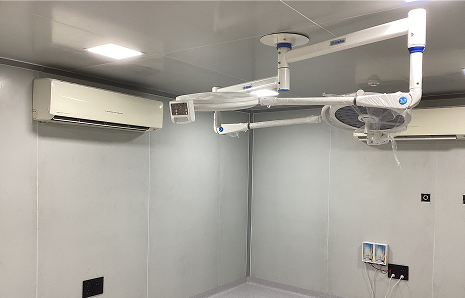
Opportunity: For infrastructure partners and solution providers, this translates into strong demand for construction, HVAC & clean systems, OT modular solutions, and smart hospital technologies.
Increased investment through mergers, acquisitions, and private equity
Rising demand for advanced treatments and specialized services
Growth in medical tourism fueled by cost-competitive, high-quality care
- Rise of Specialized & Super-Specialty Care Units
As disease patterns shift toward chronic and lifestyle conditions, hospitals are investing heavily in specialized care wings (e.g., oncology, cardiology, orthopedics). This trend supports superior patient outcomes and provides competitive differentiation.
Advanced imaging, robotic surgery, and precision care units are becoming common in tertiary care hospitals.
Dedicated infrastructure for cancer care and cardiac services is now a key investment area.
- Focus on Efficiency Through Engineering & Operation Systems
Hospital infrastructure is increasingly recognized as more than just physical construction — it’s about system engineering: medical gas pipelines, advanced HVAC, infection-controlled ventilation, facility management systems, and secure power backups are crucial to modern care delivery.
Systems that ensure safety, reliability, and clinical compliance are foundational for both public and private hospitals.
Conclusion
The trajectory of hospital infrastructure in India is set on a course of innovation, decentralization, and patient-centric design. From digital transformation and smart technologies to sustainable construction and policy support, these trends are reshaping how healthcare is delivered. For infrastructure partners like AUM Industries, aligning solutions with these trends — such as modular OT design, cleanroom HVAC, smart facility integration, and ergonomic hospital engineering — positions you at the forefront of this healthcare revolution.
Add a Comment